Retail Sports Betting Handle Declines Sharply Across Four Key States in First Half of 2026
Yves Peters · Sep 2, 2026

Retail Sports Betting Handle Declines Sharply Across Four Key States in First Half of 2026
Data compiled from official reports across New York, New Jersey, Illinois and Ohio reveals that retail sports betting handle dropped 26.7 percent during the first half of 2026 when compared with the same period in the prior year, while online handle held essentially steady with a gain of just 0.2 percent. By June 2026 retail operations accounted for only 1.0 percent of combined handle in these states, totaling $50.4 million out of $4.97 billion overall. New Jersey’s Division of Gaming Enforcement has confirmed it will stop separating retail figures in monthly releases beginning with July 2026 data, reflecting the category’s reduced footprint, and operators including DraftKings have already shuttered prominent retail sites such as the Wrigley Field sportsbook.
Market Breakdown Shows Consistent Retail Contraction
Figures for the first six months of 2026 indicate that every one of the four largest reporting markets experienced retail declines, although the pace varied by jurisdiction. Combined online volume remained nearly unchanged, which kept total handle levels relatively stable even as physical locations lost ground. Observers note that the shift has accelerated since early 2025, when retail still represented a noticeably larger slice of overall wagering activity in these states.
The $50.4 million retail total recorded in June alone illustrates how far the segment has fallen; twelve months earlier the same four states reported retail handle more than one-third higher. Online platforms absorbed the overwhelming majority of activity, reaching $4.92 billion in June 2026 and pushing the retail share down to the 1.0 percent mark. Those who track monthly releases point out that the pattern holds across both high-volume weekends and quieter midweek periods, suggesting the drop is structural rather than seasonal.
New Jersey Ends Separate Retail Reporting
New Jersey’s Division of Gaming Enforcement announced the change in reporting format after reviewing data trends through mid-2026. Starting with July figures, monthly reports will present combined handle totals without isolating the retail component. Officials cited the category’s small and continuing decline as the reason for the adjustment, noting that separate tracking no longer provides meaningful additional insight for regulators or the public.
The move aligns with similar decisions in other jurisdictions that have already consolidated their statistics. Industry participants expect the streamlined format to reduce administrative steps for both the state and operators, while still capturing the dominant online segment. Data compiled via RG.org New Jersey statistics pages from official DGE monthly reports shows the retail share has followed a steady downward trajectory since at least 2024, making the policy shift a logical next step.
Operator Adjustments Include Location Closures
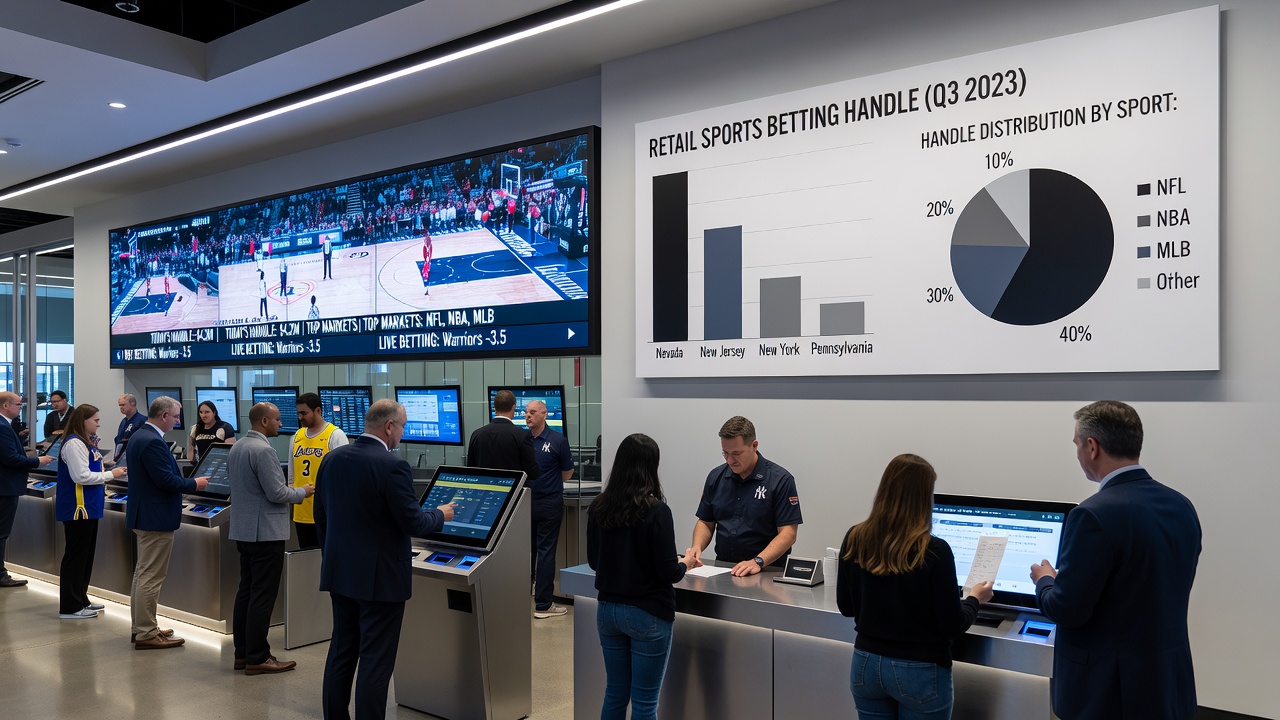
DraftKings closed its Wrigley Field sportsbook in Chicago during the first half of 2026, one of several retail sites the company has scaled back across the four-state region. Other major operators have similarly reduced physical footprints, converting some locations into smaller kiosks or eliminating them entirely. Those who follow licensing records note that the number of active retail permits in New York and Illinois has also edged lower since late 2025, reflecting reduced operator interest in maintaining large-scale venues.
The closures come at a time when mobile and desktop platforms continue to capture nearly all new customer acquisition. Retail locations that remain open have focused on high-profile events or integrated entertainment offerings in an attempt to sustain foot traffic, yet overall handle volumes have not recovered. Reports indicate that several venues now operate with reduced staffing and shorter hours compared with peak periods two years earlier.
Context for the Broader Handle Figures
Handle represents the total amount wagered before payouts, providing a standard measure of market size across jurisdictions. In the four states examined, online channels accounted for the bulk of growth in prior years, yet that expansion leveled off during the first half of 2026. Retail’s contraction therefore stands out as the primary driver of the overall percentage change recorded in the period.
Monthly sports wagering reports through June 2026 document the divergence clearly, with retail totals falling each successive month relative to the year-ago baseline. The combined $4.97 billion figure for June illustrates how online platforms now dominate the landscape in these mature markets. Experts tracking the sector emphasize that the four states together represent a significant portion of national activity, making the retail share decline noteworthy for operators and regulators alike.
Looking Ahead After June 2026
With New Jersey’s reporting change taking effect in July and similar consolidations under discussion elsewhere, future data releases will present a unified total rather than separate retail and online lines. Operators continue to evaluate remaining physical sites, and some have signaled plans to convert additional locations into hybrid models that emphasize mobile ordering alongside limited in-person betting windows. The September 2026 reports, once released, will be the first full quarter produced under the new format in New Jersey and will allow direct comparison with earlier combined totals.
Conclusion
The first-half 2026 numbers establish a clear inflection point for retail sports betting in the four largest reporting markets. As online handle remained essentially flat and retail volume fell by more than a quarter, the physical segment’s share of total activity reached just 1.0 percent by June. New Jersey’s decision to stop breaking out retail figures starting in July reflects that reality, while operator closures such as the Wrigley Field site underscore ongoing adjustments in the sector. The resulting data landscape will present combined figures that more accurately mirror current wagering patterns across New York, New Jersey, Illinois and Ohio.